Sony- Fe 50mm F18 Standard Lens (Sel50f18f) Review
Verdict
Pros
- Fantabulous image quality
- Low price
Key Specifications
- Review Price: £239.00
- 50mm focal length
- f/ane.8 maximm aperture
- 186g
- 68.6 10 59.5mm
What is the Sony FE 50mm f/1.8?
It's no secret that the Blastoff 7 series of total-frame meaty system cameras (CSC) has been a runaway success for Sony. By providing excellent prototype quality in a package that's smaller and more than portable than any comparable full-frame DSLR, information technology has become one of the nearly pop of the new brood of mirrorless systems.
Its importance to Sony is best illustrated past the contrast between the company's rapid expansion of the new, full-frame Iron lens range over the by 2 years, and the relative stagnation of both the APS-C E-mount and legacy Alpha-mount systems.
One of Sony's contempo additions to its full-frame line-up is the Atomic number 26 50mm f/one.8. At but £239, it's the firm's almost affordable FE optic by some manner. The focal length volition exist instantly familiar to generations of film users; for many years 50mm f/one.8 lenses were supplied with 35mm SLRs every bit standard. Traditionally, they offer a combination of excellent image quality and a usefully big maximum discontinuity for low-light shooting, while beingness more than compact and less expensive compared with their f/1.4 cousins.
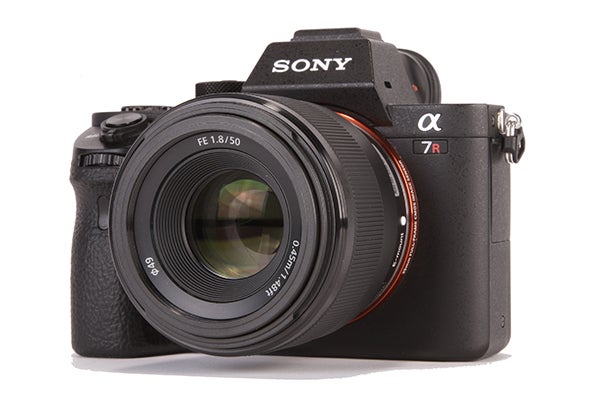 The FE 50mm f/1.eight, paired with a Sony A7R
Information technology's ofttimes claimed that 50mm lenses give a field of view similar to the human being eye, although given the extent of our peripheral vision this is an oversimplification. Just it is true to say that lenses around the forty-50mm bracket tend to bring a very natural perspective to images, imposing neither the wideangle distortion of shorter focal lengths, nor the compression effects typical of telephotos. Because of these qualities, they've gained the label 'normal'.
However, technology has moved on since we were shooting moving-picture show and focusing manually. In these days of high-quality zooms, in-body paradigm stabilisation and ISO capabilities across the dreams of film users, the attractions of the 50mm prime lens are less clear. So does the Iron 50mm f/one.viii still warrant a identify in the Blastoff seven user's kit bag?
Sony FE 50mm f/1.eight – Features
Fifty-fifty at a cursory glance, the FE 50mm f/1.viii is unusually sized for this type of lens. However, a wait inside its 60mm-long barrel reveals why: there's a lot of empty space betwixt the mountain and the rear element. In essence, Sony has made an adapted version of an SLR lens, starting with the classic double Gauss optical pattern that most fast 50mm primes take traditionally been based upon, then adding an adapter tube to place information technology the correct altitude from the sensor.
 The large discontinuity allows selective focusing with shallow depth of field
It'southward non quite that unproblematic, though, because while the six-chemical element, five-group optical formula sounds adequately standard, Sony has employed an aspheric element at the back, which is much less common. In principle, this should go a long way to eliminating spherical aberration, which tends to be a problem with fast primes, robbing images of their sharpness at large apertures. It'southward as well claimed to reduce aberrations such as coma towards the edges of the frame.
The aperture diaphragm consists of 7 curved blades that are designed to maintain a about-circular opening at wider settings for more than attractive blur characteristics. Up front end there's a non-rotating 49mm filter thread and a bayonet mountain for the attachment of the included cylindrical ALC-SH146 hood.
The lens can be used on Sony'due south E-mount APS-C cameras such as the Blastoff 6300, on which information technology gives a 75mm equivalent bending of view popular for people pictures. However, different Sony's existing APS-C-defended East 50mm f/1.8 OSS, in that location's no optical stabilisation, which makes the FE lens a less practical choice for users of the smaller format. Of course, users of second-generation Alpha seven models will do good from in-torso image stabilisation.
Sony FE 50mm f/1.8 – Build and handling
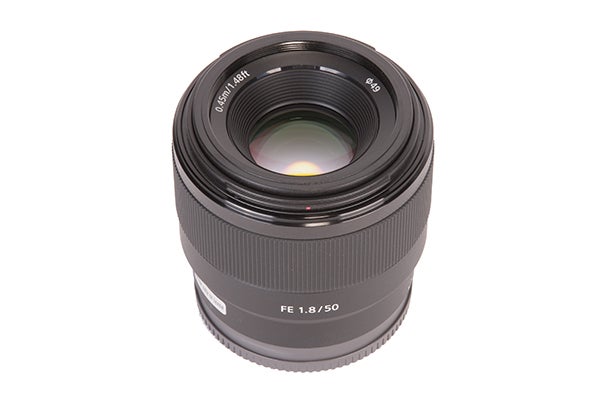
Weighing just 186g, the Fe 50mm f/1.8 is distinctly lightweight as full-frame lenses become, cheers to its predominantly plastic barrel construction. The finely ridged transmission-focus ring has a hard plastic covering, while in a reassuring bear on, the mountain is metallic. The lens is smaller than any of Sony's FE zooms, and when used on an Alpha 7 body it makes for a adequately compact, discreet gear up-upwardly. However, it'due south not as small equally Sony'due south FE 35mm f/2.8 and FE 28mm f/2 primes, which use eyes designed for the curt flange distance of the Eastward-mount.
Sony FE 50mm f/1.8 – Focusing
One characteristic of the FE 50mm f/ane.8 that has carried over from traditional manual-focus SLR lenses relates to focusing. Unlike more modern designs, which overwhelmingly utilise high-speed internal focusing, the Atomic number 26 50mm f/1.8 works by racking the unabridged optical unit dorsum and forrad instead. Indeed, at its minimum focus distance of 0.45m, the forepart of the lens extends well-nigh 1cm frontward from its infinity position. This approach isn't a problem for transmission focusing, but turns out to be far from ideal for autofocus.
Indeed, when information technology comes to AF, this is probably the to the lowest degree satisfactory lens I've used for many a year. Even when used on the Blastoff 7R II with its much-lauded on-scrap phase-detection, autofocus is slow and often feels uncertain. The lens tends to noticeably overshoot the marker and readjust back to correct focus – behaviour that's much more typical of a dissimilarity-detection system. Considering the focus motor has to move lots of glass around this isn't a quick process, and I ofttimes found that I was held upward for a second or two waiting for the lens to achieve focus. Video shooters will likewise find that the whirring of the DC motor is audible on their soundtrack.
 The 50mm focal length is ideal for street photography, simply the lens's deadening focusing tin exist a problem if events change apace
With static subjects this sluggishness isn't too detrimental to the moving picture-taking process, although it is rather irritating. Fortunately, focus accuracy is consistently high, merely so long as you place the AF area on a reasonably high-contrast target. Only when faced with trying to get a quick shot, it all-too-frequently fails to react in time. To provide some context, Canon's recent EF 50mm f/1.8 STM too uses a unit-focus, double Gauss design merely is noticeably quieter and quicker.
Y'all can, of class, focus manually, using the broad, smoothly rotating ring on the barrel. This employs a focus-by-wire machinery that instructs the lens's internal motor to move the optical unit. Like most such systems, information technology allows very authentic focusing when used in concert with the camera'south focus aids, such as magnified and peaking views. But it's not especially intuitive – for example, there's no change in resistance when the focus reaches the end of its travel. To exist fair, this is commonplace with CSC lenses, and you'll only get more tactile transmission focusing from rather pricier designs.
Sony FE 50mm f/1.8 – Epitome quality
The Fe 50mm f/i.8's focusing may be disappointing, but its optical quality is quite the opposite. Indeed, the images it creates are by and large excellent given its toll. Broad open, it combines impressive sharpness in the focal plane with bonny groundwork blur. Stopped downwardly to its optimum apertures it gives excellent levels of item right beyond the frame. This behaviour is broadly typical of double Gauss 50mm f/1.8 lenses in general, but the aspherical element seems to be doing its chore, and corner sharpness at large apertures is rather better than usual for designs that rely purely on conventional spherical lens surfaces.
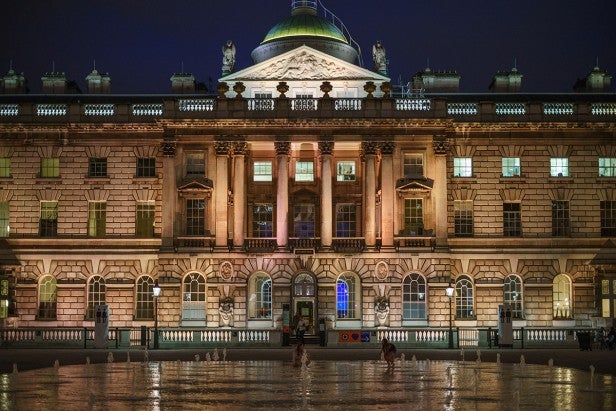 With its fast f/1.eight discontinuity the lens is ideal for hand-held shooting in low calorie-free
One further indicate that's easily disregarded is that lenses this good tin also give sharper-than-usual shots when stopped down considerably, because while the softening effect of diffraction is impossible to avert, in that location are few other aberrations to chemical compound it.
Distortion is, to all intents and purposes, non-existent every bit is lateral chromatic aberration. Vignetting is quite visible at f/1.8, but information technology isn't visually objectionable and adds character to selective focus shots that frequently helps to concentrate attention on the subject field.
However, there is some longitudinal chromatic aberration, which manifests equally coloured fringing around brilliant highlights when shooting at large apertures, particularly in out-of-focus areas of the frame. While this tin sometimes be detrimental to your images and is difficult to remove in post-processing, you'll struggle to find a better-corrected fast prime at this kind of price.
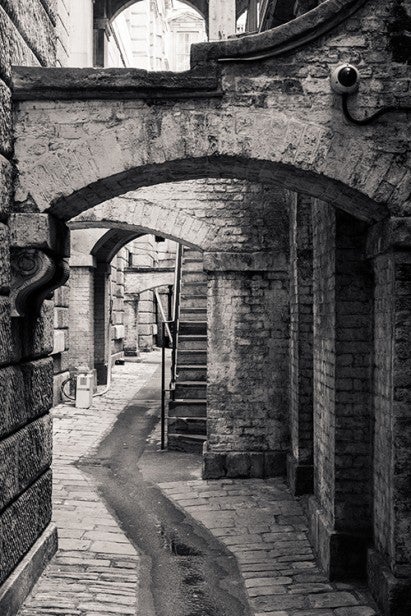
Dist ortion is exceptionally depression, so straight lines stay straight
Out-of-focus backgrounds are usually rendered smoothly, although brilliant highlights tend to come out somewhat hard-edged, and become increasingly oval as y'all move off-heart.
Overall, the FE 50mm f/1.8 is capable of giving some very nice-looking images. More modern designs such as the Sony Atomic number 26 Planar T* 50mm f/one.4 ZA that we reviewed recently (AP twenty August) can certainly requite even better results, merely at a very much higher toll.
Sony Fe 50mm f/1.8 – Sharpness, shading and distortion
Sharpness: There's not much to complain about in terms of sharpness, with the lens delivering pretty good results wide open up. It improves progressively every bit it's stopped downwards, with the very sharpest images obtained around f/5.half dozen-f/11. The corners are measurably softer than the heart at all apertures up to f/eight, but cheers to the aspheric chemical element, they are better than what we would expect from a 50mm f/i.8 at large apertures.
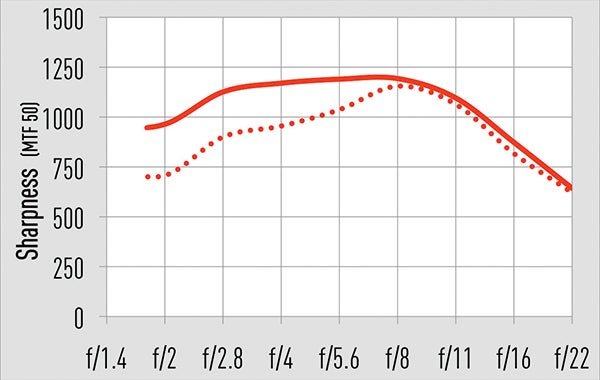 Solid line: Centre Dotted line: Corner
Solid line: Centre
Dotted line: Corner
Shading: As usual for this kind of lens, vignetting is quite obvious at large apertures, with a maximum of 1.v stops fall-off at the corners of the frame at f/1.8. But it reduces chop-chop on stopping downwards, dropping to a barely noticeable 0.six stops at f/2.8 and disappearing entirely by f/4.
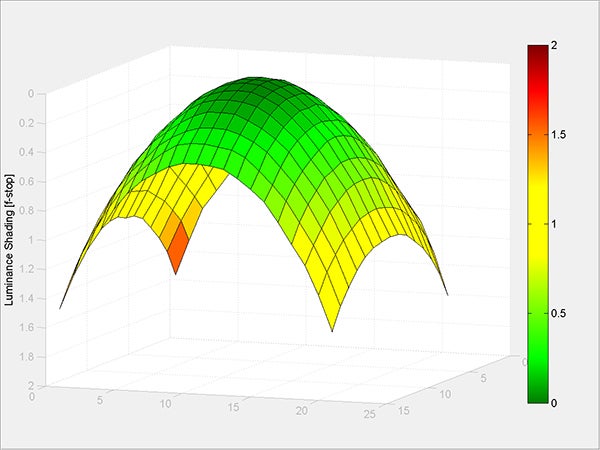
f/1.8
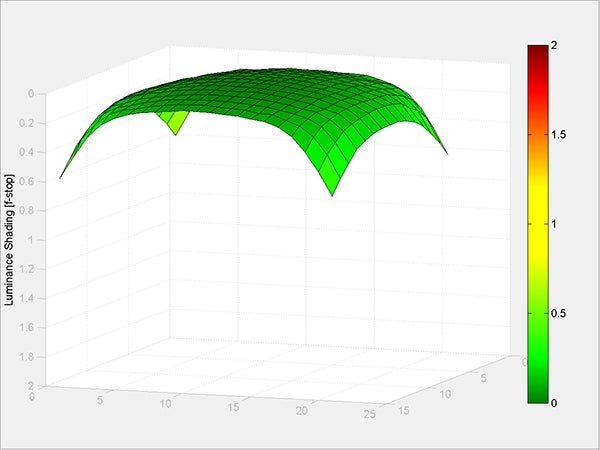
f/2.8
Distortion
Typically for a 50mm prime, distortion is exceptionally depression. Unlike with many CSC lenses this almost-perfect correction is entirely optical and doesn't rely on any software compensation. In concert with the lens's normal focal length, this results in subjects being fatigued in a very natural-looking fashion.
Should I buy the Sony FE 50mm f/i.8?
Information technology'south like shooting fish in a barrel to sympathize what Sony has washed with this FE 50mm f/1.8 lens. Past giving it a tried-and-tested double Gauss design, the lens tin can deliver a very decent image quality, pregnant the company is spared the need to expend resources developing a new optical formula. The result is a lens costing a lot less than Sony'southward existing Sonnar T* Iron 55mm f/1.eight ZA lens. But this approach comes with drawbacks, too – well-nigh notably, the painfully slow autofocus.
This is a shame, as it makes the lens difficult to recommend wholeheartedly. Information technology's OK if you lot mainly accept your time over shooting static subjects, just this kind of fast prime number is well suited to genres where fast focusing is desirable, such equally ecology portraiture and street photography. For these, the 55mm f/i.8 would exist a amend option. However, users on a budget who can tolerate the AF are unlikely to be disappointed by the prototype quality.
Verdict
Groovy image quality from a wide-aperture standard prime lens, but the autofocus speed lets it downwardly.
Trusted Score
Source: https://www.trustedreviews.com/reviews/sony-fe-50mm-f-1-8
0 Response to "Sony- Fe 50mm F18 Standard Lens (Sel50f18f) Review"
Post a Comment