Does the Us Have an Absolute Advantage in Beef
Chapter 33. International Trade
33.1 Absolute and Comparative Advantage
Learning Objectives
By the finish of this department, you will exist able to:
- Ascertain absolute reward, comparative advantage, and opportunity costs
- Explain the gains of trade created when a country specializes
The American statesman Benjamin Franklin (1706–1790) once wrote: "No nation was ever ruined by trade." Many economists would express their attitudes toward international trade in an even more positive manner. The testify that international merchandise confers overall benefits on economies is pretty strong. Merchandise has accompanied economical growth in the U.s.a. and around the world. Many of the national economies that take shown the almost rapid growth in the terminal few decades—for case, Japan, South Korea, China, and India—have done so by dramatically orienting their economies toward international merchandise. There is no modern example of a state that has close itself off from world merchandise and notwithstanding prospered. To understand the benefits of trade, or why we trade in the outset place, we need to empathise the concepts of comparative and absolute advantage.
In 1817, David Ricardo, a businessman, economist, and member of the British Parliament, wrote a treatise called On the Principles of Political Economic system and Revenue enhancement. In this treatise, Ricardo argued that specialization and gratis trade benefit all trading partners, even those that may be relatively inefficient. To meet what he meant, we must be able to distinguish between absolute and comparative advantage.
A country has an absolute advantage in producing a skilful over another country if it uses fewer resources to produce that good. Absolute advantage tin be the result of a state's natural endowment. For example, extracting oil in Kingdom of saudi arabia is pretty much just a matter of "drilling a hole." Producing oil in other countries can require considerable exploration and costly technologies for drilling and extraction—if indeed they have any oil at all. The Us has some of the richest farmland in the world, making it easier to grow corn and wheat than in many other countries. Guatemala and Colombia have climates especially suited for growing coffee. Chile and Zambia accept some of the world'due south richest copper mines. As some have argued, "geography is destiny." Chile will provide copper and Guatemala will produce coffee, and they volition trade. When each country has a product others demand and it can be produced with fewer resources in one country over another, then it is easy to imagine all parties benefitting from trade. However, thinking about trade just in terms of geography and absolute reward is incomplete. Merchandise really occurs because of comparative reward.
Recall from the chapter Choice in a World of Scarcity that a country has a comparative reward when a good can exist produced at a lower cost in terms of other appurtenances. The question each land or company should be asking when it trades is this: "What exercise we give up to produce this good?" Information technology should exist no surprise that the concept of comparative reward is based on this idea of opportunity cost from Option in a Earth of Scarcity. For example, if Zambia focuses its resource on producing copper, its labor, land and financial resource cannot exist used to produce other goods such as corn. As a issue, Zambia gives upward the opportunity to produce corn. How do we quantify the toll in terms of other goods? Simplify the problem and assume that Republic of zambia just needs labor to produce copper and corn. The companies that produce either copper or corn tell you that it takes 10 hours to mine a ton of copper and xx hours to harvest a bushel of corn. This means the opportunity cost of producing a ton of copper is 2 bushels of corn. The next section develops absolute and comparative advantage in greater detail and relates them to trade.
Visit this website for a listing of articles and podcasts pertaining to international trade topics.

A Numerical Example of Absolute and Comparative Advantage
Consider a hypothetical world with two countries, Saudi Arabia and the United States, and two products, oil and corn. Further presume that consumers in both countries desire both these goods. These goods are homogeneous, meaning that consumers/producers cannot differentiate between corn or oil from either state. There is only i resources available in both countries, labor hours. Saudi Arabia tin produce oil with fewer resources, while the United states of america can produce corn with fewer resources. Table 1 illustrates the advantages of the two countries, expressed in terms of how many hours information technology takes to produce one unit of each good.
| Country | Oil (hours per butt) | Corn (hours per bushel) |
|---|---|---|
| Kingdom of saudi arabia | ane | 4 |
| United States | 2 | one |
| Tabular array 1. How Many Hours It Takes to Produce Oil and Corn | ||
In Tabular array 1, Saudi Arabia has an accented reward in the production of oil because it only takes an hour to produce a barrel of oil compared to two hours in the The states. The United States has an absolute advantage in the production of corn.
To simplify, let's say that Saudi arabia and the United states each have 100 worker hours (see Tabular array 2). We illustrate what each country is capable of producing on its own using a production possibility frontier (PPF) graph, shown in Figure i. Recollect from Choice in a World of Scarcity that the production possibilities frontier shows the maximum amount that each country can produce given its express resources, in this case workers, and its level of technology.
| Country | Oil Production using 100 worker hours (barrels) | Corn Product using 100 worker hours (bushels) | |
|---|---|---|---|
| Saudi arabia | 100 | or | 25 |
| U.s. | fifty | or | 100 |
| Tabular array 2. Production Possibilities before Merchandise | |||
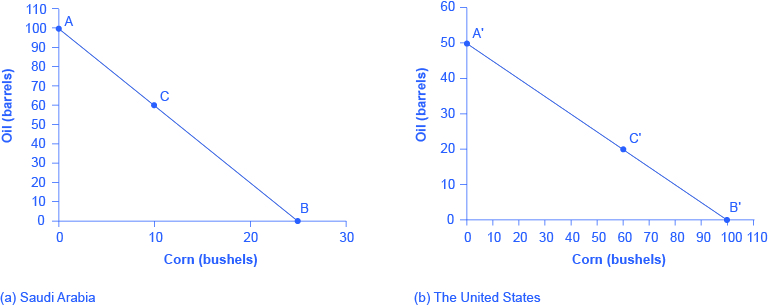
Arguably Saudi and U.S. consumers want both oil and corn to live. Allow's say that before trade occurs, both countries produce and consume at point C or C'. Thus, before merchandise, the Saudi Arabian economy will devote 60 worker hours to produce oil, equally shown in Table 3. Given the information in Table 1, this selection implies that it produces/consumes 60 barrels of oil. With the remaining 40 worker hours, since it needs four hours to produce a bushel of corn, it can produce only x bushels. To be at point C', the U.S. economy devotes 40 worker hours to produce 20 barrels of oil and the remaining worker hours tin be allocated to produce 60 bushels of corn.
| Country | Oil Product (barrels) | Corn Product (bushels) |
|---|---|---|
| Kingdom of saudi arabia (C) | threescore | x |
| United states (C') | 20 | lx |
| Total World Production | lxxx | seventy |
| Table 3. Production before Trade | ||
The slope of the product possibility frontier illustrates the opportunity toll of producing oil in terms of corn. Using all its resources, the United States can produce fifty barrels of oil or 100 bushels of corn. And so the opportunity cost of 1 barrel of oil is 2 bushels of corn—or the slope is i/2. Thus, in the U.South. production possibility frontier graph, every increase in oil production of one butt implies a decrease of 2 bushels of corn. Saudi arabia can produce 100 barrels of oil or 25 bushels of corn. The opportunity price of producing one barrel of oil is the loss of one/iv of a bushel of corn that Saudi workers could otherwise have produced. In terms of corn, find that Kingdom of saudi arabia gives up the to the lowest degree to produce a barrel of oil. These calculations are summarized in Table 4.
| Country | Opportunity cost of one unit — Oil (in terms of corn) | Opportunity price of one unit — Corn (in terms of oil) |
|---|---|---|
| Saudi Arabia | ¼ | 4 |
| United States | 2 | ½ |
| Table 4. Opportunity Cost and Comparative Advantage | ||
Again recollect that comparative advantage was defined as the opportunity toll of producing goods. Since Saudi arabia gives upwards the to the lowest degree to produce a butt of oil, (1414 < 22 in Tabular array iv) information technology has a comparative advantage in oil production. The United states gives up the to the lowest degree to produce a bushel of corn, so it has a comparative advantage in corn production.
In this case, there is symmetry between accented and comparative advantage. Kingdom of saudi arabia needs fewer worker hours to produce oil (accented reward, see Tabular array ane), and also gives upwards the least in terms of other goods to produce oil (comparative advantage, see Table 4). Such symmetry is not ever the case, as we will show afterwards we accept discussed gains from trade fully. Merely starting time, read the post-obit Clear It Upward feature to make sure you understand why the PPF line in the graphs is direct.
Can a production possibility frontier be directly?
When you starting time met the production possibility frontier (PPF) in the chapter on Choice in a World of Scarcity it was drawn with an outward-angle shape. This shape illustrated that as inputs were transferred from producing one good to another—like from education to health services—at that place were increasing opportunity costs. In the examples in this chapter, the PPFs are drawn as straight lines, which ways that opportunity costs are abiding. When a marginal unit of labor is transferred away from growing corn and toward producing oil, the decline in the quantity of corn and the increase in the quantity of oil is ever the same. In reality this is possible but if the contribution of additional workers to output did not alter every bit the calibration of production inverse. The linear production possibilities frontier is a less realistic model, but a straight line simplifies calculations. It also illustrates economical themes like absolute and comparative reward simply every bit clearly.
Gains from Trade
Consider the trading positions of the U.s.a. and Saudi Arabia later they have specialized and traded. Earlier merchandise, Saudi Arabia produces/consumes sixty barrels of oil and 10 bushels of corn. The United States produces/consumes twenty barrels of oil and 60 bushels of corn. Given their current production levels, if the United States tin trade an amount of corn fewer than lx bushels and receives in commutation an corporeality of oil greater than 20 barrels, it will gain from trade. With trade, the United States can consume more of both goods than it did without specialization and merchandise. (Think that the affiliate Welcome to Economics! defined specialization as it applies to workers and firms. Specialization is besides used to describe the occurrence when a land shifts resources to focus on producing a good that offers comparative reward.) Similarly, if Kingdom of saudi arabia can trade an amount of oil less than 60 barrels and receive in commutation an corporeality of corn greater than x bushels, it volition have more than of both goods than information technology did before specialization and trade. Table 5 illustrates the range of trades that would do good both sides.
| The U.Southward. Economy, after Specialization, Will Benefit If It: | The Saudi Arabian Economy, later on Specialization, Will Benefit If It: |
|---|---|
| Exports no more than sixty bushels of corn | Imports at least 10 bushels of corn |
| Imports at least twenty barrels of oil | Exports less than 60 barrels of oil |
| Tabular array 5. The Range of Trades That Benefit Both the United states of america and Saudi arabia | |
The underlying reason why trade benefits both sides is rooted in the concept of opportunity price, equally the following Clear It Up feature explains. If Saudi arabia wishes to aggrandize domestic production of corn in a earth without international trade, then based on its opportunity costs it must give up four barrels of oil for every 1 additional bushel of corn. If Saudi Arabia could detect a manner to give up less than four barrels of oil for an boosted bushel of corn (or equivalently, to receive more than than one bushel of corn for 4 barrels of oil), it would exist ameliorate off.
What are the opportunity costs and gains from merchandise?
The range of trades that volition benefit each country is based on the country'due south opportunity cost of producing each skilful. The United states tin produce 100 bushels of corn or 50 barrels of oil. For the United States, the opportunity toll of producing one barrel of oil is two bushels of corn. If nosotros divide the numbers above past 50, nosotros get the same ratio: one barrel of oil is equivalent to two bushels of corn, or (100/fifty = ii and fifty/50 = one). In a merchandise with Kingdom of saudi arabia, if the Usa is going to give up 100 bushels of corn in exports, it must import at least 50 barrels of oil to be just besides off. Clearly, to gain from trade it needs to be able to gain more than a half barrel of oil for its bushel of corn—or why merchandise at all?
Recall that David Ricardo argued that if each land specializes in its comparative advantage, it will benefit from trade, and total global output will increase. How can we show gains from trade equally a issue of comparative advantage and specialization? Table 6 shows the output assuming that each state specializes in its comparative advantage and produces no other good. This is 100% specialization. Specialization leads to an increase in total world production. (Compare the total world production in Table 3 to that in Table six.)
| State | Quantity produced afterwards 100% specialization — Oil (barrels) | Quantity produced after 100% specialization — Corn (bushels) |
|---|---|---|
| Saudi Arabia | 100 | 0 |
| The states | 0 | 100 |
| Total World Production | 100 | 100 |
| Table 6. How Specialization Expands Output | ||
What if we did not take complete specialization, as in Table 6? Would in that location still exist gains from trade? Consider another example, such as when the United states of america and Saudi Arabia start at C and C', respectively, as shown in Figure 1. Consider what occurs when trade is immune and the U.s.a. exports 20 bushels of corn to Saudi Arabia in exchange for twenty barrels of oil.
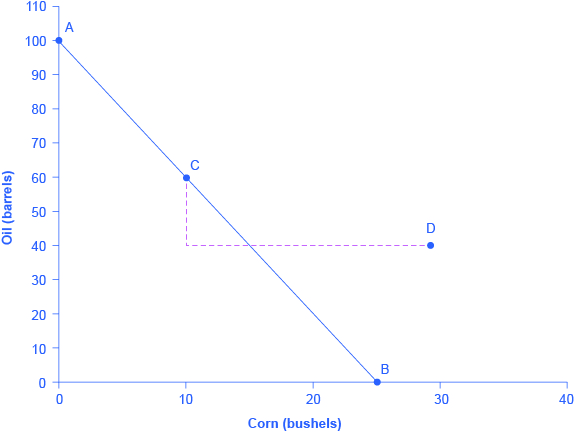
Starting at indicate C, reduce Saudi Oil production by 20 and exchange it for twenty units of corn to reach point D (run across Effigy 2). Observe that even without 100% specialization, if the "trading price," in this case 20 barrels of oil for xx bushels of corn, is greater than the country's opportunity cost, the Saudis will gain from trade. Indeed both countries eat more of both appurtenances afterwards specialized product and merchandise occurs.
Visit this website for trade-related data visualizations.

Key Concepts and Summary
A country has an absolute advantage in those products in which it has a productivity border over other countries; information technology takes fewer resources to produce a product. A country has a comparative reward when a good can be produced at a lower price in terms of other goods. Countries that specialize based on comparative advantage gain from trade.
Self-Check Questions
- True or False: The source of comparative advantage must be natural elements like climate and mineral deposits. Explain.
- Brazil can produce 100 pounds of beef or 10 autos; in dissimilarity the United States can produce twoscore pounds of beef or xxx autos. Which state has the absolute advantage in beef? Which state has the absolute advantage in producing autos? What is the opportunity cost of producing one pound of beef in Brazil? What is the opportunity cost of producing one pound of beef in the United States?
- In France it takes one worker to produce one sweater, and one worker to produce i bottle of wine. In Tunisia it takes 2 workers to produce one sweater, and iii workers to produce one bottle of wine. Who has the absolute advantage in production of sweaters? Who has the absolute advantage in the production of wine? How can you tell?
Review Questions
- What is absolute reward? What is comparative advantage?
- Under what weather does comparative advantage atomic number 82 to gains from trade?
- What factors does Paul Krugman place that supported the expansion of international trade in the 1800s?
Critical Thinking Questions
- Are differences in geography behind the differences in absolute advantages?
- Why does the United States not have an absolute reward in coffee?
- Expect at Self-Check Question iii. Compute the opportunity costs of producing sweaters and wine in both France and Tunisia. Who has the lowest opportunity cost of producing sweaters and who has the lowest opportunity price of producing wine? Explain what it means to have a lower opportunity toll.
Problems
France and Tunisia both have Mediterranean climates that are excellent for producing/harvesting dark-green beans and tomatoes. In French republic it takes two hours for each worker to harvest green beans and ii hours to harvest a tomato plant. Tunisian workers demand just one hour to harvest the tomatoes but four hours to harvest light-green beans. Assume there are simply two workers, ane in each country, and each works 40 hours a week.
- Draw a production possibilities frontier for each land. Hint: Remember the production possibility frontier is the maximum that all workers can produce at a unit of fourth dimension which, in this problem, is a week.
- Identify which land has the absolute advantage in green beans and which country has the absolute advantage in tomatoes.
- Identify which country has the comparative reward.
- How much would France have to give upward in terms of tomatoes to gain from trade? How much would information technology have to give up in terms of dark-green beans?
References
Krugman, Paul R. Pop Internationalism. The MIT Press, Cambridge. 1996.
Krugman, Paul R. "What Practise Undergrads Demand to Know well-nigh Trade?" American Economic Review 83, no. 2. 1993. 23-26.
Ricardo, David. On the Principles of Political Economic system and Taxation. London: John Murray, 1817.
Ricardo, David. "On the Principles of Political Economy and Revenue enhancement." Library of Economic science and Freedom. http://world wide web.econlib.org/library/Ricardo/ricP.html.
Glossary
- absolute advantage
- when 1 land can use fewer resources to produce a skilful compared to another land; when a land is more productive compared to another country
- gain from trade
- a country that can consume more than information technology tin produce as a result of specialization and trade
Solutions
Answers to Self-Check Questions
- False. Anything that leads to different levels of productivity between ii economies can be a source of comparative advantage. For case, the education of workers, the knowledge base of engineers and scientists in a country, the part of a split-upward value concatenation where they have their specialized learning, economies of scale, and other factors can all determine comparative advantage.
- Brazil has the absolute advantage in producing beef and the United States has the accented advantage in autos. The opportunity toll of producing one pound of beef is i/x of an auto; in the United States it is three/4 of an machine.
- In answering questions similar these, information technology is often helpful to brainstorm by organizing the information in a tabular array, such as in the following table. Notice that, in this instance, the productivity of the countries is expressed in terms of how many workers it takes to produce a unit of a production.
Land I Sweater I Bottle of wine France 1 worker one worker Tunisia 2 workers 3 workers Tabular array 7. In this case, France has an accented advantage in the production of both sweaters and wine. You can tell because it takes French republic less labor to produce a unit of measurement of the proficient.
Source: https://opentextbc.ca/principlesofeconomics/chapter/33-1-absolute-and-comparative-advantage/
0 Response to "Does the Us Have an Absolute Advantage in Beef"
Post a Comment